
The last (BOO!) of five (BOO again!) CicLAvia events in 2026 is upon us this Sunday. It’s the 69th edition of the Los Angeles metropolitan area’s premier open streets event, and it’s going to be rather…nice. This will actually be the first time since 2018 (The April 22 “Heart of the Foothills” route from San Dimas to Claremont that y’allz had to drive or take Metrolink to) that a CicLAvia takes place entirely outside Los Angeles City limits, and if you’re feeling some deja vu, it’s true, we’ve kinda-sorta done this route before – it was on May 31, 2015 when CicLAvia – Pasadena last ran. It was also a slightly longer route – there was the main route along Colorado, an intersecting leg along Raymond Avenue and another intersecting leg along Lake Avenue, which was omitted this time around. This 2.7-mile route is much shorter than a standard CicLAvia, though larger than a CicLAmini (of which we didn’t have any in 2026…although this is pretty much a CicLAmini in spirit). Despite its short length, Pasadena packs a lot of history, so this Epic CicLAvia Tour guide will have plenty of entries for an under 3-mile route.
Weatherwise, Sunday will be immune to the wrath of Super El Niño, with partly-cloudy skies and a high of 69º (extra-nice…).
As usual — Happy CicLAvia, Go Rams, Go Lakers, Go Kings Go, Go Bruins or Trojans and see you or not see you on the streets!
If you found this Epic CicLAvia Tour guide useful and visit any of these sites, please add the #EpicCicLAviaTour hashtag to any social media post that includes it. The Militant will be glad to re-tweet!
And if you appreciate The Militant’s work, kick him a little love via PayPal! He *hates* asking for money, but you know how it is these days…A Militant’s gotta pay his bills! He sacrifices a lot of his time to do this! Your support is much appreciated!
Support The Militant Angeleno!
https://www.paypal.com/donate/?hosted_button_id=K5XC5AM9G33K8
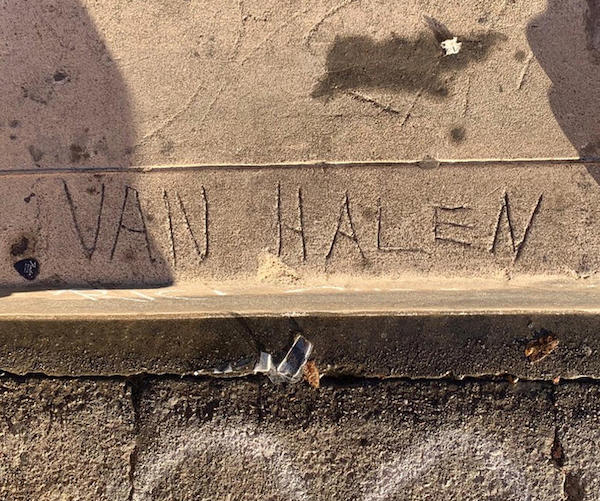
1. Van Halen Curb Graffiti
500 N. Allen Ave, Pasadena
1976
Okay, a bit off of the CicLAvia route, but since many of y’allz will be arriving via the Metro (A) Line Allen Station, check out this spot just a couple blocks away: “Van Halen” etched onto the concrete curb in front of the Eric’s Clocks store. “So what?” you might say, as fans of rock bands do that stuff all the time. Ahh, but this is different: “Van Halen” was scrawled onto the pavement by brothers Eddie and Alex Van Halen themselves in 1976 before the band made it big (Their self-titled debut album was released in 1978). And though not part of the Epic CicLAvia Tour, if you want to dig a little deeper, you can visit the Van Halen brothers’ childhood home, just two blocks away on 1881 Las Lunas Street (just east of Allen).
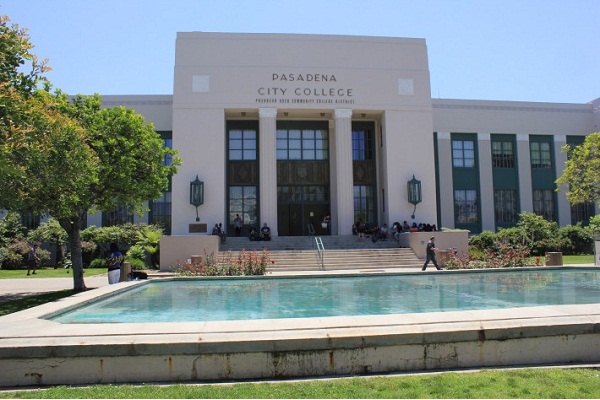
2. Pasadena City College
1570 E. Colorado Blvd, Pasadena
1924
What does actor Nick Nolte, director John Singleton, Worf from Star Trek, the original Superman and Jimmy Olson, math teacher con ganas Jaime Escalante, singer Kenny Loggins, all of the original members of Van Halen, the late Coach Jerry Tarkanian, the great Jackie Robinson (who later transferred to UCLA) and Lakers great Michael Cooper have in common? They all attended Pasadena City College. This school, established in 1924 as Pasadena Junior College, later shared the campus with the original Pasadena High School from 1928 to 1960. In 1954, the college merged with nearby John Muir College and formally changed its name to its current moniker. The college markets itself as the “#1 Associate Degree for Transfer,” meaning, you probably won’t stay long here anyway. But they sure have a pretty campus though. Despite its long list of noble alumni, the school has also produced some dark characters, such as Robert F. Kennedy’s assassin Sirhan Sirhan and Westboro Baptist Church founder Fred Phelps.
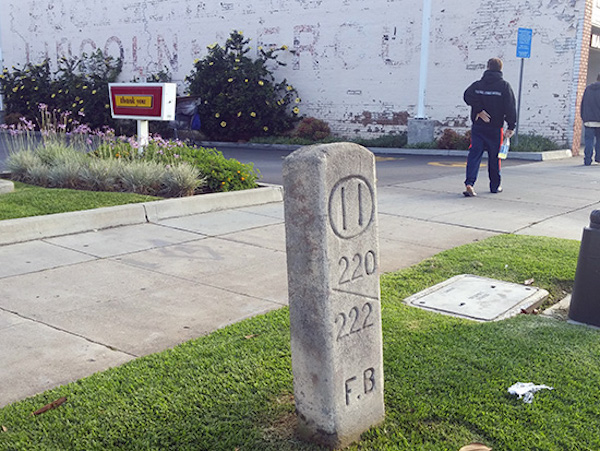
3. Route 66 Marker
1320 Colorado Blvd, Pasadena
1906
On the grass parkway in front of the McDonald’s drive thru on Colorado and Hill stands a cryptic stone marker which reads:
(11)
220\222
F.B
It may or may not be a tombstone. Which makes it look even creepy. What do the numbers mean? What does “FB” mean? Did they predict Facebook or something? Actually, it was the gravesite of the a laborer identified as #11, and he was the 220th of 222 people to die while constructing Colorado Boulevard. The “FB” may to may not be his initials…Okay, just kidding. It was actually a stone highway marker placed near there by Los Angeles County in 1906 — before the road was paved. It turns out in those days, highway signs were made of stone instead of sheet metal. The “11” meant that it was 11 miles until the next highway marker, which was at the old Los Angeles County Courthouse (where Grand Park now stands in front of Los Angeles City Hall). The “220\222” were the block numbers as designated by the county’s road surveying system. And the “F.B” stood for “Foothill Boulevard,” which the street was originally named. In 1926, that route was designated as part of US Route 66. It is the oldest stone marker in Pasadena, and the sole surviving one of three such markers. The marker was originally placed 25 feet to the west — where the driveway is, and was moved to the present location in 1994. For some bonus added history, check out the faded lettering of the wall facing the McD’s parking lot. It’s from the old Foothill Motors Lincoln-Mercury dealership that existed from 1947 to the late 1980s.
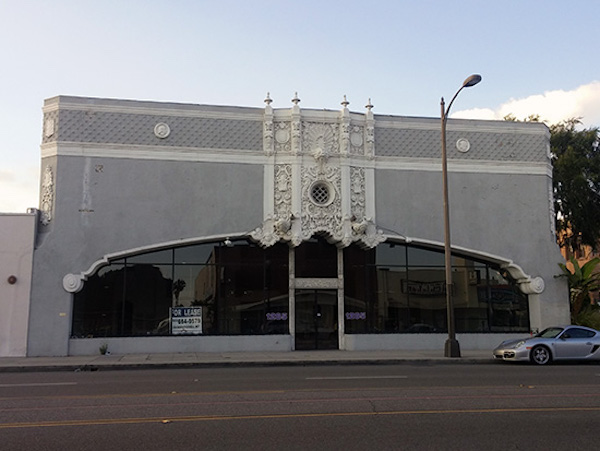
4. Howard Motor Company Building
1285 E. Colorado Blvd
1927
Located in what was considered Pasadena’s automobile dealership row (see the Foothill Motors faded wall across the street), Conveniently located along Route 66, this Spanish Colonial Revival building with cherry churro chourio Churrigueresque (like North Hollywood’s St. Charles Borromeo church from the last CicLAvia) ornamentation was an attractive showroom for the Howard Motor Company, and later Bush-Morgan Motors from the 1930s to the 1950s. It is currently vacant (want to open a Churrigueresque Churro shop?), but was last used as an auto showroom as recently as the 1990s.
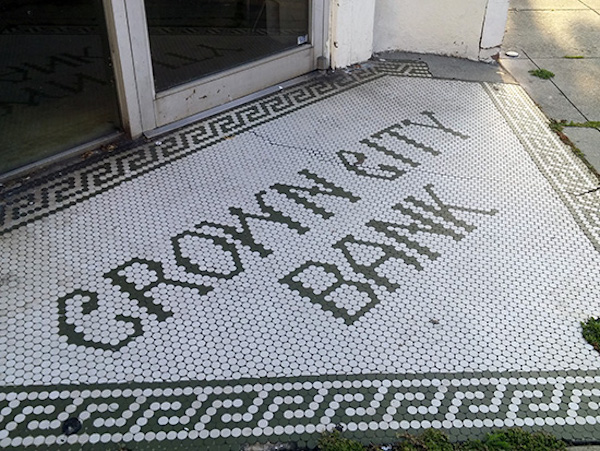
5. Crown City Bank Entrance
1176 E. Colorado Blvd, Pasadena
1906
The same year the mysterious highway marker was placed down the street, Crown City Bank opened up its main branch here on what is now the Pasadena Coin and Stamp Company. If you’re into philately or numismatics, you’ll probably be into what’s inside. But if not, do observe the 109 year-old tile mosaic entrance. Over the years the building has also hosted a car dealership, a glass and mirror shop, a refrigerator store, and a men’s clothing store. Yet the “Crown City Bank” entrance has remained untouched. What is “Crown City” exactly? Why, it’s Pasadena’s official nickname. And while you’re here, drop by across the street to the Militant-Approved Book Alley bookstore! A great selection of local history titles!
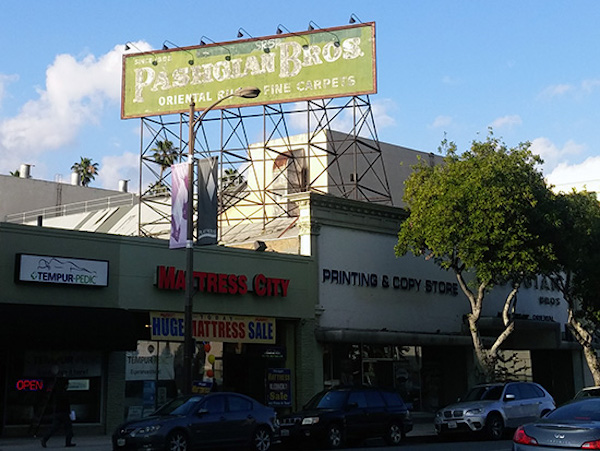
6. Pashgian Bros. Oriental Rugs
993 E. Colorado Blvd, Pasadena
1903
Underneath this faded, old school-looking billboard is one of the longest-running businesses in Pasadena. Established in 1889 — as old as the Tournament of Roses Parade — this oriental rug store founded by John and Moses Pashgian has been a Pasadena institution for over one and a quarter centuries. Moses Pashgian was even the Grand Marshal of the 1915 Rose Parade, and the brothers are considered the founders of Pasadena’s Armenian American community. The Pashgian family still makes its presence in the city. John Pashgian’s son, the late Aram Pashgian, was a member of the Tournament of Roses Association, and Aram’s daughter, Helen Pashgian, is a renowned visual artist whose work has been displayed at LACMA
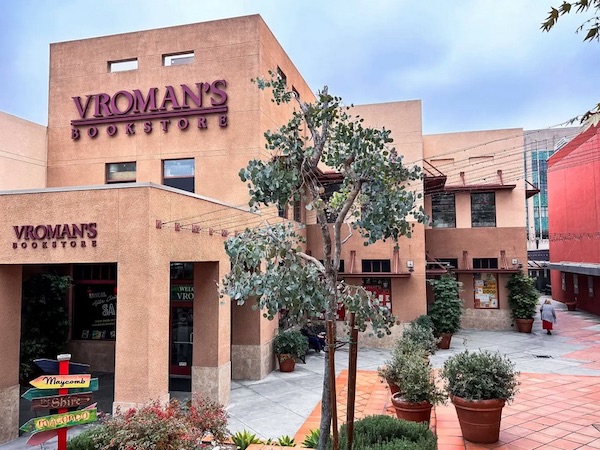
7. Vroman’s Bookstore
695 E. Colorado Blvd, Pasadena
1894
Established during the Grover Cleveland administration (though the present location dates back to 1929), this is the oldest and largest independent bookstore in Southern California. Founded by Adam Clark Vroman at its original location on 60 E. Colorado Blvd, the store also sold photographic supplies as well as books. In addition to an awesome bookstore, try to chillax at the beautiful landscaped courtyard int the back.
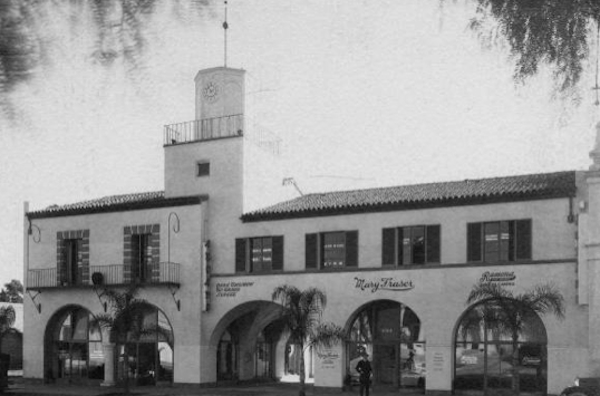
8. Arcade Lane
696 E. Colorado Blvd, Pasadena
1927
Across the street from Vroman’s, and having stood there two years before the bookstore moved into the block, is this arcade (no, not the video game kind, but you just hang on tight for that one…) building on the CicLAvia route. This picturesque building, an award-winning design by Pasadena architects Sylvanus Marston and Garrett Van Pelt, was built as a replica of a marketplace in Budapest, Hungary. It once was the location of the second-ever Coffee Bean & Tea Leaf store. The picture above depicts the building in the 1930s.
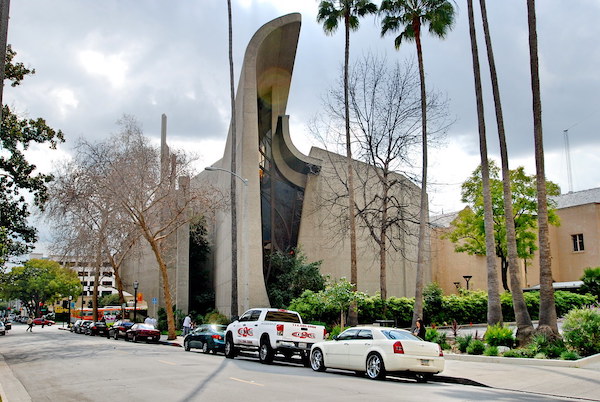
9. Pasadena Presbyterian Church
585 E. Colorado Blvd, Pasadena
1908/1976
Despite Pasadena’s ethnic-kinda-sounding name (we went over its origin before), it was pretty much founded by a bunch of WASP-folk from Indiana, and the influence of Midwestern American culture still looms large, from the Tournament of Roses organization to the general vibe of the city. From the city’s founding in the 1880s to the 1920s was when the city’s large Protestant churches were built along the Colorado Boulevard corridor. The Pasadena Presbyterian Church, whose congregation dates back to 1875 when it was located on Orange Grove and California street, had built two houses of worship before this one was built in 1908. The church (as in the organization) was also heavily influential in the city’s culture: It broadcasted its KPPC (hence the call letters) AM and FM radio stations from 1924 to 1971 which featured religious programming as well as more secular news, talk and music shows (including the first radio home of The Dr. Demento Show (!) in 1970). The main sanctuary building was damaged in the 1971 Sylmar earthquake (the other original church buildings on the campus still remain), and a new one was built in 1976. It features an Aeolian-Skinner pipe organ which was rescued from the original 1908 sanctuary.
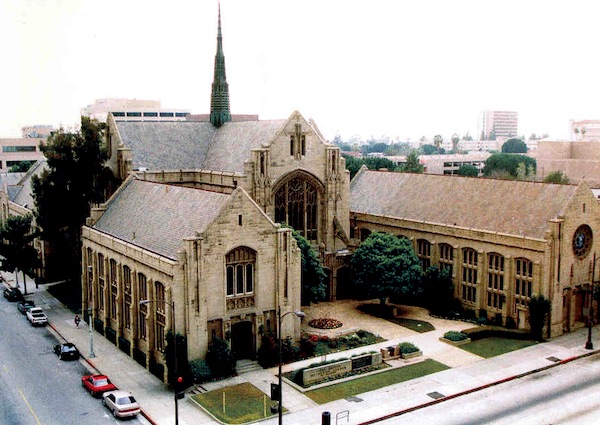
10. First United Methodist Church of Pasadena
500 E. Colorado Blvd, Pasadena
1923
This congregation dates back to the original 1872 settlers from Indiana, who originally built the church in two previous locations (the second of which was damaged in a tornado (!) in December 1891). After outgrowing its previous buildings, the church moved to its present location in 1923 and built its current English Gothic-style sanctuary, which was designed by architect Thomas P. Barber. It also includes a 1930 Skinner pipe organ.
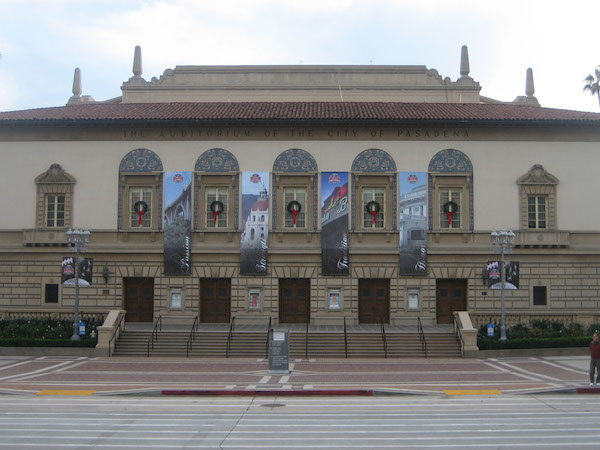
11. Pasadena Civic Auditorium
330 E. Green St, Pasadena
1931
Just south of the CicLAvia route, across from Paseo Colorado (formerly the Plaza Pasadena mall) is this stately hall designed by architects George Edwin Bergstrom, Cyril Bennett and Fitch Haskell, this 3,029-seat venue was the home of the Emmy Awards from 1977 to 1997. The 1983 NBC Motown 25 special, was taped here, which means, yes, Michael Jackson’s moonwalk was performed to a worldwide audience in this here building. In recent years, the NBC show America’s Got Talent does their tapings here.
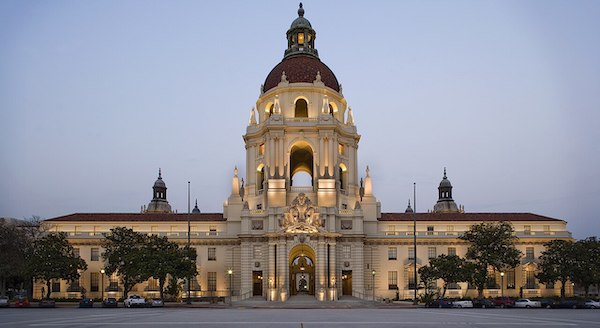
12. Pasadena City Hall
100 N. Garfield Ave, Pasadena
1927
Fans of the TV show Parks & Recreation will easily recognize this building for some reason…
Built a year before Los Angeles’ iconic city hall, this second-most iconic city hall building in Southern California was largely inspired by the 1915 San Francisco City Hall. In fact, the city government wanted one similar to that, so they hired SF city hall architects Arthur Brown, Jr. and John Bakewell, Jr. to design one for the Crown City, this time with Mediterranean Revival and Spanish Colonial Revival elements.
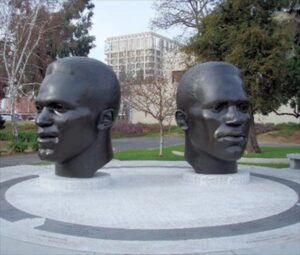
13. Jackie and Mack Robinson Memorial
Holly St. and Garfield Ave, Pasadena
1997
Legendary Brooklyn Dodger and UCLA Bruin Jackie Robinson and his brother, Olympic medalist Mack Robinson, were both raised right here in Pasadena, in a small house (no longer standing) at 121 Pepper Street, off of North Fair Oaks. This memorial sculpture, designed by artist Ralph Helmick, features, nine-foot, 2700-pound likenesses of the Robinson brothers’ heads. It was dedicated in 1997, the 50th anniversary year of Jackie Robinson breaking the color barrier.
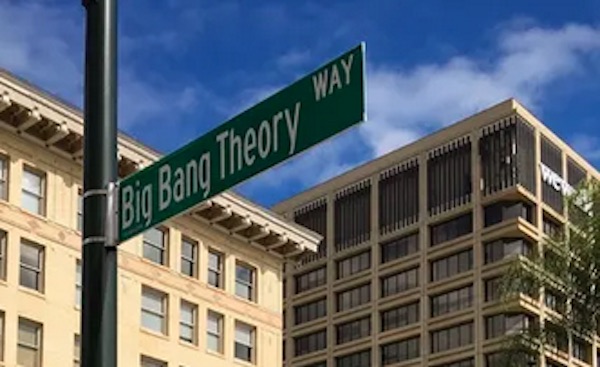
14. Big Bang Theory Way
Pedestrian alley from Colorado Blvd to Holly St, Pasadena
2016
Airing for 12 seasons from 2007 to 2019, the CBS sitcom, The Big Bang Theory took place right here in Pasadena. This pedestrian alleyway running from Colorado Boulevard to Holly Street between Arroyo Parkway and Raymond Avenue was dedicated by the City of Pasadena in 2016 to commemorate the show’s 200th episode. The alleyway didn’t always exist, as it was previously the right-of-way for the Santa Fe Railway’s Pasadena Subdivision from 1885 to 1994. Soon after, a cut-and-cover trench was dug to allow construction of the Pasadena Blue Line light rail project below that right-of-way, which opened as the Metro Gold Line in 2003 (and is known today as the Metro (A) Line). Certainly a ferroequinophile like Sheldon Cooper himself would appreciate the alley’s heritage. Bazinga!
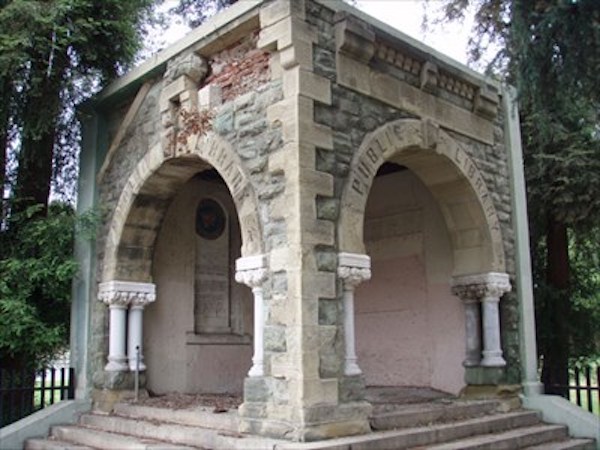
15. Pasadena Public Library Ruins
Raymond Ave and Walnut St, Pasadena
1890
Located at the northwest corner of Pasadena’s Memorial Park (It is not, The Militant repeats, not a cemetery, it’s quite literally a park that contains various memorial statues and plaques to war veterans and historic individuals) is this freestanding arched structure that looks like some old rich person’s tomb (again, Memorial Park is not a cemetery…). The structure was the entrance to the original Pasadena Public Library (prior to the 1930s, the park was known as the not-macabre-at-all “Library Park”), which operated here from 1890 to 1927. It was damaged in the 1933 Long Beach Earthquake and demolished in 1954 (man, the speed of city bureaucracy…). In 1955 the city of Pasadena decided to keep the arched entrance intact and dedicate it as another memorial in this park, this time to the city’s founders.
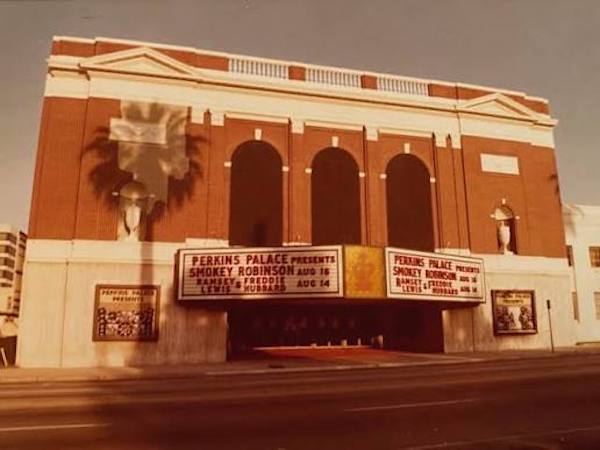
16. Raymond Theatre/Perkins Palace
129 N. Raymond Ave, Pasadena
1921
Originally built as Jensen’s Raymond Theatre (if you know your Los Angeles history, it’s the same Jensen’s that opened the bowling alley in Echo Park and the former silent movie theatre on Melrose in East Hollywood (now the Ukrainian Culture Center – which was one of the stops in the first few Epic CicLAvia Tours), it was an early venue for vaudeville and silent movie screenings. In the 1940s, it was sold to Crown Holding Corporation and re-named the Crown Theatre (because, as you know by now, Pasadena is “The Crown City” – and don’t you forget it), showing movies until the 1960s. In the early 1970s, one of the theatre’s owners was a local ophthalmologist named Dr. Nathan Roth (whose son, David Lee, was attending Pasadena City College at the time and met these guys named Michael, Alex and Eddie). In the late ’70s, the venue was owned by local businessman Mark Perkins who re-named it Perkins Palace, which became the legendary stage for local, national and international rock, pop, punk and new wave acts, from Fleetwood Mac to The Go-Gos to New Order to Oingo Boingo to, yes, Van Halen. Today, the building remains as part of a new condo/retail complex.
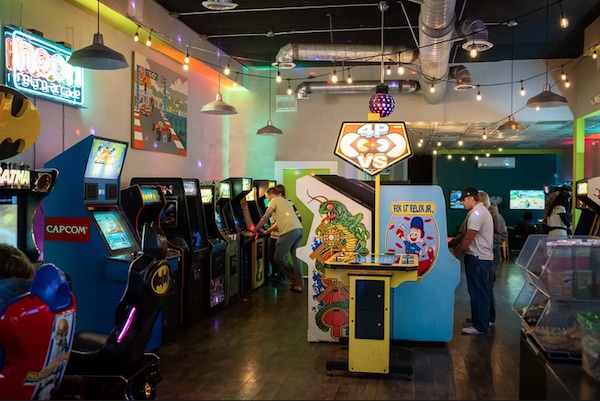
17. Neon Retro Arcade
28 S. Raymond Ave, Pasadena
2015
The second “arcade” on the CicLAvia route is this one — a video arcade, that opened in 2015, and specializes in retro (as in 1980s and 1990s, you know, the good stuff) video games, as well as pinball machines for the older school set. If you lovingly remembered the uber-legendary Pak Mann Arcade on 1775 Colorado Blvd back in the day, this is somewhat of a consolation. Anyone wanna play some Tempest or Street Fighter? Note: If the arcade is closed, come by after 11 a.m. on Sunday when it opens. After then it will, quite literally, be on like Donkey Kong.
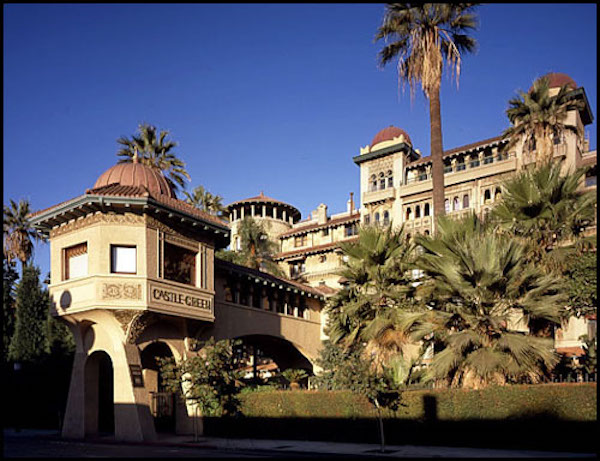
18. Hotel Green/Castle Green
99 S. Raymond Ave, Pasadena
1893
One of Pasadena’s most iconic structures, this Moorish-Mediterranean Revival luxury hotel, which was designed by local architect Frederick Roehrig, was built to serve the Santa Fe Railway station across the street. Prior to its opening, it was purchased by civil war veteran and snake oil salesman George G. Green (hence Green Street). The hotel was once home to the Tournament of Roses Association and the Valley Hunt Club, which us 99-percenters only really hear about during the Tournament of Roses Parade.
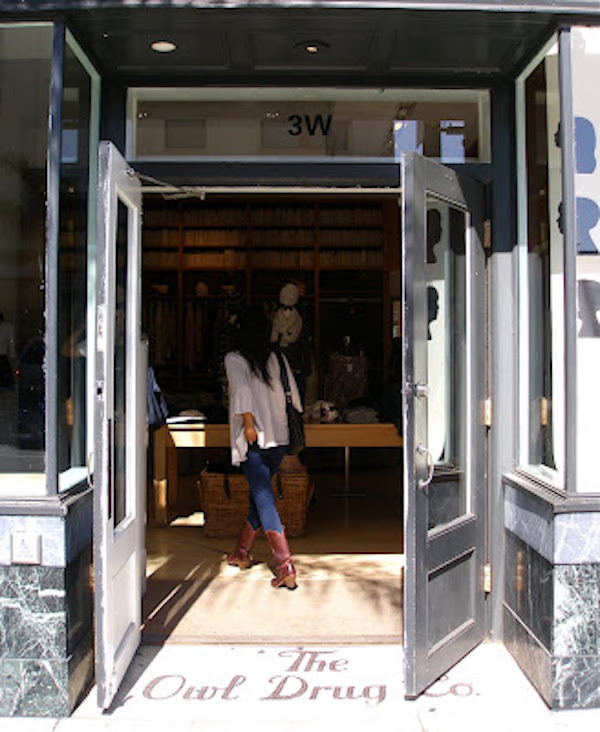
19. The Owl Drug Co. (Alo)
3 W. Colorado Blvd, Pasadena
1916
Look down at the entryway for this Alo store in Old Town Pasadena and you’ll see “The Owl Drug Co.” It was a San Francisco-based national chain drugstore and soda fountain (yeah, total old school) that opened its first Pasadena location here almost a century ago. It operated until the 1940s when it was purchased by Rexall Drug Store. It changed hands over the years, weathering the neighborhood’s decline and eventual revitalization towards the end of the 20th century.
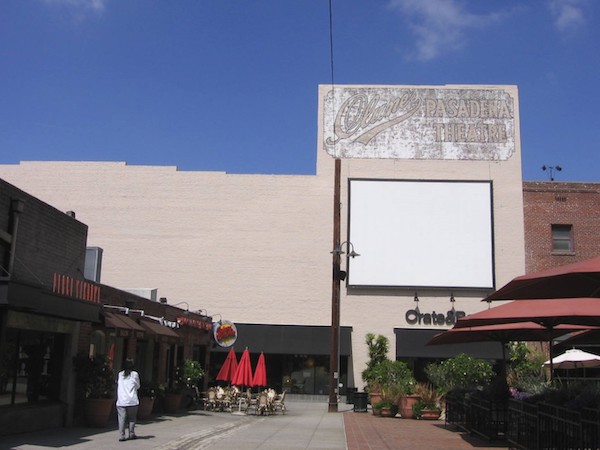
20. Site of Clune’s Pasadena Theatre
61 W. Colorado Blvd, Pasadena
1911
If you’re into faded building signs, you’re in for a treat. The north and east walls of this building still bear the weather-beaten signage for “Clune’s Pasadena Theatre,” a vaudeville and silent movie theatre built 104 years ago. John Philip Sousa once performed there with his orchestra. It became part of the Fox Theatres chain in the 1920s, screening Fox, and later 20th Century Fox films until the 1950s. Today, a Vuori sportswear store and a Rothy’s shoe store operate in the former theatre space.
Stay Militant and Happy CiclaDENA on Sunday! Don’t forget to blast some Van Halen and wear your crowns!

You must be logged in to post a comment.